 Best
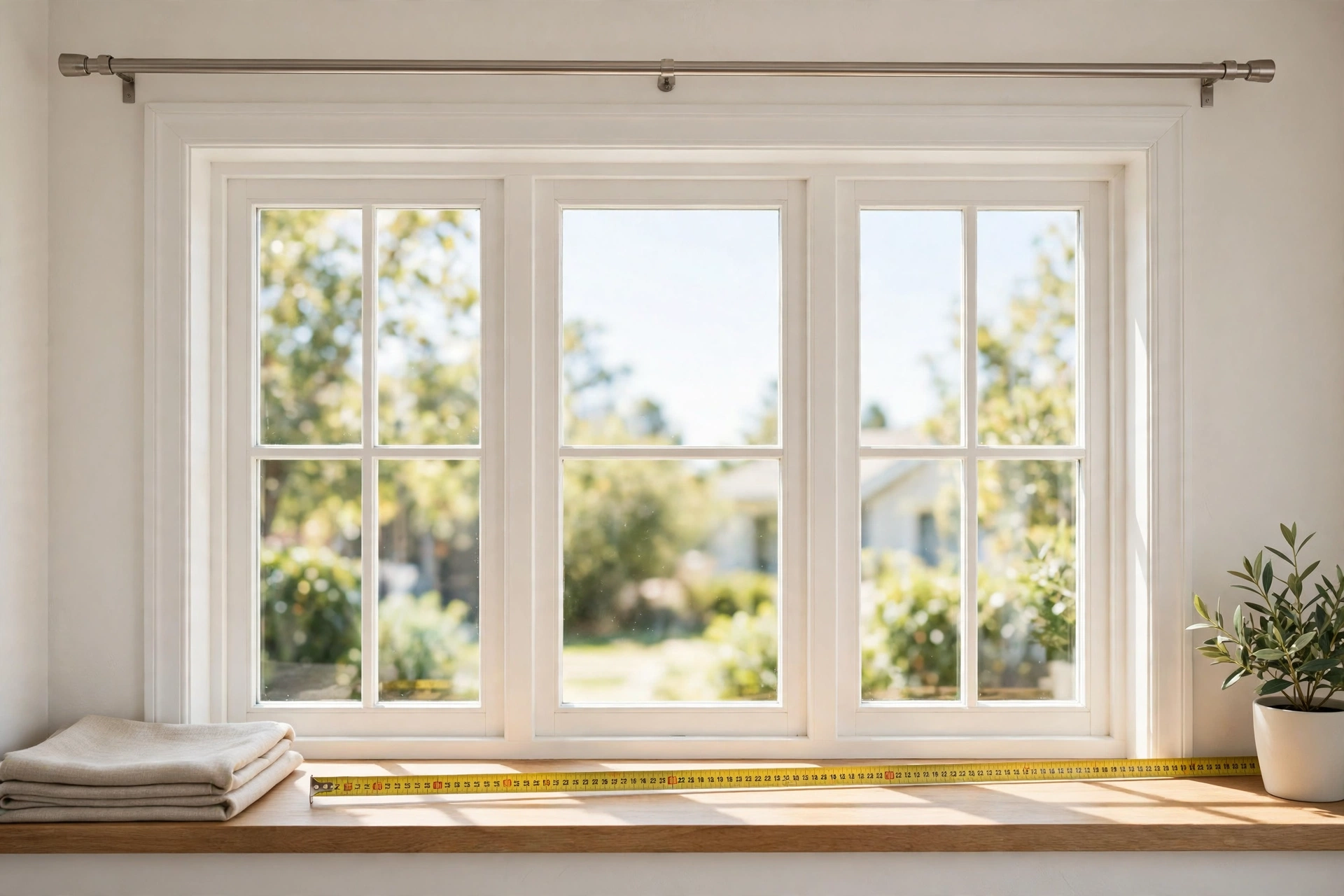
How to Measure for Curtains
Measure the rod, not just the window. This guide walks through rod width, fullness, drop, and panel count, with two worked examples you can copy.
Curtains that miss by a couple of inches are all anyone notices. Most fit problems start before buying, with a measurement taken from the wrong point. This guide covers the four numbers that decide fit: rod width, total fabric width, panel count, and drop. Work through them in order and check each number against the listing before you order.
Measuring diagram: rod width and drop
Window
Measure the rod span first, then the drop. The rod sits higher and wider than the frame.
What You Need Before You Start
You need a metal tape measure, a pencil, paper or a phone note, and a step stool for high rods. A metal tape stays straight, while a cloth tape can sag or stretch and give a short reading. Measure each window on its own, even windows that look identical, and write the window name next to each set of numbers.
Take every length measurement in three places: left, middle, and right. For the drop, use the shortest of the three, so no panel drags. For width, use the largest of the three, so the rod covers the widest point. Note handles, radiators, or furniture that could block the fabric.

Inside Mount or Outside Mount: Which One Are You Measuring For?
Decide the mount first, because it changes every number that follows. An inside mount hangs the rod inside the window recess. An outside mount hangs the rod on the wall or trim above and beyond the frame, so the curtain covers the frame and part of the wall beside it.
An inside mount suits a tidy look, often in kitchens and bathrooms, and needs a recess deep enough for rod and fabric to clear the glass and any handle. Measure it this way: measure the inside recess width at the top, middle, and bottom, and use the smallest reading as the rod width. Measure the recess depth, and compare it with the bracket and panel depth on the listing: the panel must clear the handle when drawn, or the inside mount will not work and an outside mount is the better choice. Measure the inside drop from the inside top of the recess to the sill or floor, in three places, and use the shortest reading. It lets more light slip around the edges, since fabric stops at the frame. An outside mount is the common choice for bedrooms and living rooms. It makes the window look larger, blocks light better at the sides, and forgives small errors because fabric overlaps the frame. If a rod is already in place, measure that hardware; How to Hang Curtains covers fixing positions.
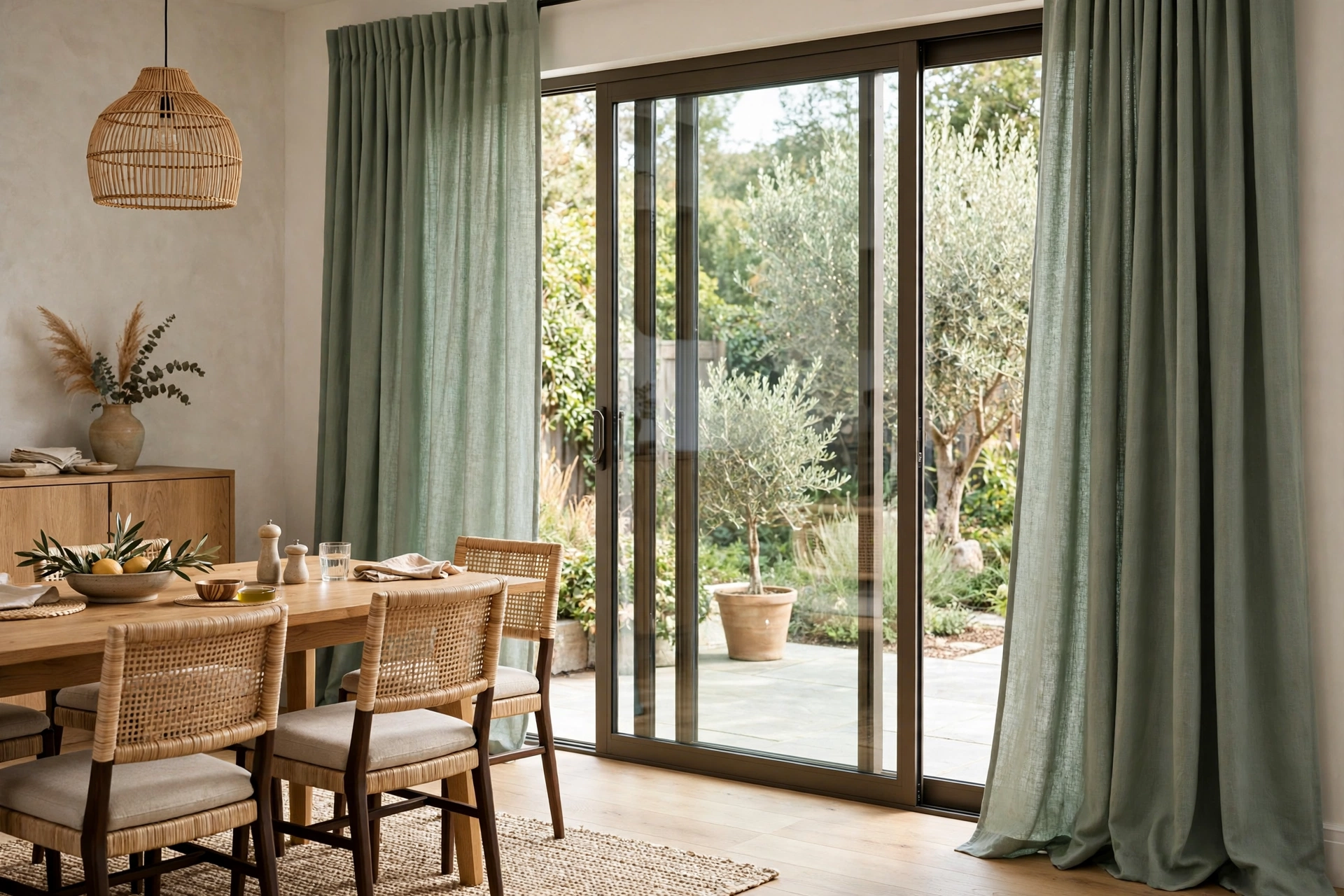
How Wide Should the Rod Be?
Rod width is the distance fabric must cover, measured bracket to bracket, with decorative finials excluded. Finials sit beyond the brackets and hold no fabric, so counting them makes the plan wider than the rod it must fill. If a rod is already up, measure bracket to bracket. For a track, measure end to end, adding any middle overlap where the two track curtains meet and overlap in the center.
If no rod is up yet, start with window width from the outside edge of one side of the trim to the outside edge of the other side, then add an extension on each side. As a starting point, use 4-6 inches on each side, and up to 8-10 inches on each side where open panels must pull fully clear of the glass. That clear space beside the glass is called stack-back: the width bunched fabric takes up when curtains are open. To estimate stack-back, bunch one panel to its bunched width: gather the full panel width in your hands and measure the bunch, or hang it on the rod, push it to one side, and measure it. Multiply by the number of panels per side. That total must fit inside the extension on that side.
Choose the extension by the job the open curtain must do. A small extension is enough if panels only frame the window. A larger extension is needed for a fully clear view, or for thick fabric that bunches wide when open. Rod width is then window width plus left extension plus right extension. Fabric must total the fullness target for the rod width, so folds remain when closed (see the fullness section below).
How Much Fullness Do You Need?
Fullness is the ratio of total fabric width to rod width. A fullness of 1.5x means total fabric, laid flat, is one and a half times rod width. A fullness of 2x means twice rod width, and 2.5x means two and a half times. When curtains are closed, that extra fabric forms the folds. Without it, closed curtains hang flat like a sheet pulled tight.
| Fullness | Total fabric width | Look and best use |
|---|---|---|
| 1.5x | Rod width x 1.5 | Slim, calm folds. Suits light, casual fabrics and windows where curtains stay open most of the time. |
| 2x | Rod width x 2 | Soft, even folds. The standard choice for most rooms and the safest default if you are unsure. |
| 2.5x | Rod width x 2.5 | Deep, rich folds. Suits formal rooms, thick fabrics, and windows where curtains stay closed for privacy or darkness. |
A 60-inch rod at 2x needs 120 inches of total fabric. At 1.5x it needs 90 inches, and at 2.5x it needs 150 inches. Those totals are the combined width of all panels, not one panel.
Two exceptions matter. Pleated and ripple-fold headings often have fullness built into the pleats, so the listing may ask for rod width alone. Thick fabric at 2.5x can bunch wide and eat into stack-back space. If the listing gives a fullness for that fabric, follow it. If it does not, use 2x for thick fabric that must stack clear, and reserve 2.5x for thick fabric that stays mostly closed or has generous stack-back room. Fuller panels close with fewer gaps, which helps where darkness matters, as in Best Blackout Curtains. For daylight rooms, lighter fullness often looks better, as in Best Sheer Curtains.
How Many Panels Do You Need?
Panel count is total fabric width divided by the width of one panel, rounded up. Keep three widths apart: rod width is the span to cover, total fabric width is rod width times fullness, and panel width is the flat width of a single panel as stated in the listing.
Work it in three steps: find rod width, multiply by fullness for total fabric width, then divide by one panel width and round up to the smallest count that reaches or passes total fabric width. If panels are sold singly, an odd count such as 3 or 5 is fine. If panels are sold as pairs, round up to an even number for a matching pair.
Check whether the listing states panel width for one panel or for a pair, and whether it states flat or finished width after heading, which can be several inches narrower. Use finished width of one panel, and if the listing is unclear, ask the seller before ordering.
Rounding up matters. A 60-inch rod at 2x needs 120 inches of total fabric. With 50-inch panels, 120 divided by 50 is 2.4, so two panels give only 100 inches and will look stretched. Three panels give 150 inches and close with proper folds. The right answer is the smallest count that reaches or passes total fabric width, not the count closest to it from below.

How Long Should Curtains Be?
The drop, also called curtain length, is measured from the point where fabric hangs to the point where the hem should end. That starting point changes with the heading. For grommet and rod-pocket curtains, measure from the top of the rod. For pencil pleat and pinch pleat curtains hung from rings or hooks, measure from the underside of the ring or hook. For curtains on clips, measure from the bottom of the clip. Measuring from the wrong point can put the finished curtain an inch or two off.
Rod height comes first, because it sets the top of the drop. A wall rod is commonly placed 4-6 inches above the frame, or higher, near the ceiling, for a taller look. Decide rod height before measuring the drop, and keep it consistent in the same room so hems line up.
Then choose where the hem ends. Sill length ends at the sill and suits kitchens and bathrooms. Below-sill length ends just below the sill, far enough that the hem clears the sill and does not catch on it. Floor length has three finishes: float, about half an inch above the floor; kiss, just touching the floor; and puddle, with extra fabric pooling on the floor. Float is easiest to clean around. Kiss needs an exact drop and a level floor. Puddle suits formal, low-traffic rooms, with guides suggesting 2-6 inches of extra fabric.
Standard ready-made lengths are 63, 84, 96, 108, and 120 inches. If your drop falls between two, order the longer one where hemming is possible, since a long curtain can be shortened but a short one cannot be lengthened. The tables in Curtain Sizes give more detail. Measure the drop in three places, use the shortest reading, and hold the tape taut, since a sagging tape reads long.
Worked Example 1: A Standard Bedroom Window
This example uses a bedroom window 48 inches wide, trim to trim, with an outside mount, floor-length curtains, 2x fullness, and a pair meeting in the middle.
- Step 1, rod position: place the rod 5 inches above the frame, inside the 4-6 inch range, with 6 inches of extension on each side for stack-back room.
- Step 2, rod width: 48 plus 6 plus 6 equals 60 inches, measured bracket to bracket, finials excluded.
- Step 3, total fabric width: 60 times 2x equals 120 inches, the combined width of all panels, not one panel.
- Step 4, panel count: with 60-inch panels, two panels give exactly 120 inches and match the target with a clean pair. With 50-inch panels, 120 divided by 50 is 2.4, so round up to 3 panels if sold singly, or 4 for a matching two-per-side look if sold as pairs. Do not fix the count until listing panel width is known.
- Step 5, drop: readings from rod to floor are 95 inches left, 95.5 inches middle, and 94.5 inches right. Use the shortest, 94.5 inches, minus half an inch for a float finish, giving 94 inches. The nearest standard length above that is 96 inches, hemmed down by 2 inches, or order 94 inches made to measure. Check side coverage against the leak fixes in Best Blackout Curtains before ordering.
Result: rod width 60 inches, total fabric 120 inches at 2x, panel count set by listing panel width, drop 94 inches for a float finish.
Worked Example 2: A Wide Living Room Window
This example uses a living room window 96 inches wide, trim to trim, with an outside mount, floor-length curtains, 2x fullness, and panels that stack clear of the glass when open.
- Step 1, rod position: place the rod 6 inches above the frame, with 10 inches of extension on each side for stack-back room and a fully clear view. Place brackets where panels will stack, not where they block the stack.
- Step 2, rod width: 96 plus 10 plus 10 equals 116 inches. A rod this long needs a center support bracket, so check the rod listing for support spacing.
- Step 3, total fabric width: 116 times 2x equals 232 inches.
- Step 4, panel count: with 60-inch panels, 232 divided by 60 is 3.86, so 4 panels give 240 inches, close to target, two per side. With 54-inch panels, 232 divided by 54 is 4.29, so round up to 5 panels if sold singly, or 6 for a matching three-per-side look if sold as pairs. Check by the bunch method above that six panels, three per side, bunch inside the 10-inch extension on each side.
- Step 5, drop: readings from rod to floor are 107 inches, 108 inches, and 107.5 inches. Use the shortest, 107 inches, minus half an inch for a float finish, giving 106.5 inches. The nearest standard length above that is 108 inches, hemmed down by 1.5 inches, or order 106.5 inches made to measure.
Result: rod width 116 inches, total fabric 232 inches at 2x, panel count set by listing panel width, a center support bracket needed for a 116-inch rod, drop 106.5 inches for a float finish.
Wide Windows, Bay Windows, Doors, and Rentals
Wide windows follow the same math, with two extra checks. A rod over a wide span needs support about every 36 to 48 inches of span, so it does not sag: a center support bracket on a wide rod, and a second bracket on a very wide span. Stack-back room also grows with width, so a wide window often needs the larger rod extension.
Bay windows follow the same math, facet by facet. Measure each facet on its own, corner to corner, and add facet widths for total width. Use the shortest drop reading per facet, so no panel on that facet drags. Do not apply one facet's shortest reading to every facet, or panels on longer facets will float above the floor. A straight rod cannot follow bay angles, so hardware is usually a bay rod that bends at the angles or a flexible track, and width is measured along the hardware path.
Doors follow the same width logic, with one difference: the curtain must clear the door in use. Measure the full door frame width, add the same 4-6 inch extensions as windows, or 8-10 inches where panels must pull fully clear, and allow stack-back room where the door opens so fabric does not block the handle or swing. For length, a float finish keeps the hem clear at the threshold, while a puddle finish at a working door will be stepped on. A single panel pulling to one side suits a door used often.
Renters face a different constraint, not a different measurement. Width, fullness, and drop math does not change, but hardware may. No-drill and tension options sit inside the frame or on the trim, so rod height is set by the trim, and the drop is measured from that fixed point. Check weight limit, trim width, and recess depth in the listing before ordering.
For rooms where heat loss through glass matters, fabric choice after measuring is covered in Best Thermal Insulated Curtains. For a first look at the full range, Best Window Curtains sets out the main types side by side.
Mistakes Checklist: Check These Before You Order
- Rod width counted with finials included. Measure bracket to bracket, finials excluded.
- Curtain width based on window width, not rod width. Fabric must fill the rod, with fullness on top.
- Total fabric width mistaken for one panel width. Total fabric width is the combined width of all panels.
- Panel width read as a pair width, or flat width read as finished width. Use finished width of one panel from the listing.
- Fullness skipped. Panels the same width as the rod will hang flat when closed.
- Drop measured from the wrong point. Grommet tops start at the top of the rod; ring and hook tops start below the rod.
- Drop measured once, in the middle only. Measure left, middle, and right, and use the shortest reading.
- Rod height chosen after the drop is measured. Set rod height first, then measure the drop from it.
- Standard length ordered below the drop. Order the next length up where hemming is possible, or order made to measure if hemming is not possible.
- Stack-back room ignored. Thick or numerous panels need wider extensions to clear the glass when open.
- Heading fullness double-counted. If the listing builds fullness into pleats, do not multiply again without checking its instructions.
If any item changes a number, redo the steps from that number onward, since a changed rod width changes panel count.
Frequently Asked Questions
Should I measure the window or the rod?
Measure the rod if one is in place, bracket to bracket for a pole, finials excluded, or end to end for a track. If no rod is in place yet, measure the window trim to trim, add planned extensions on each side, and use that total as rod width for the fullness math.
How wide should curtains be for a standard window?
Total fabric width should be 1.5x to 2.5x rod width, with 2x as the standard choice for most rooms. A 60-inch rod at 2x needs 120 inches of total fabric. Divide that total by one panel width for panel count, rounding up.
How do I know if a panel width in a listing is for one panel or a pair?
Read the listing wording and size line carefully. Pair listings usually say so, and the size line may state width per panel or combined pair width. If unclear, ask the seller before ordering, since guessing wrong halves or doubles the fabric.
Do curtains need to touch the floor?
No, it is a style choice. Float, about half an inch above the floor, is easiest to clean around. Kiss just touches the floor and looks tailored but needs an exact drop. Puddle pools fabric on the floor and suits formal, low-traffic rooms.
What should I do if my drop falls between standard lengths?
Order the next standard length up where hemming is possible, since a long curtain can be shortened but a short one cannot be lengthened. If the gap is large or the rod sits at an unusual height, a made-to-measure length gives the exact drop.
Why do my closed curtains still show gaps at the sides?
Side gaps usually come from a rod that stops at the frame, so fabric cannot overlap it, or from too little fullness, so folds pull tight. A wider extension and the fullness in the table both help.
Does fabric type change the measurement?
Fabric type does not change the measuring steps, but it changes choices inside them. Thick fabric stacks wider and needs more stack-back room and stronger support on wide spans. Light fabric, such as linen, stacks narrow and can take higher fullness, as covered in Best Linen Curtains.
---
Last updated: 2026-10-27. Always check the listing for the panel you order, since heading style and stated panel width can change the final numbers.